NINGBO, ZHEJIANG, CHINA, September 10, 2026 /EINPresswire.com/ — Industrial processing plants frequently route highly aggressive chemical media through their fluid network pipelines. Volatile fluids like hot sulfuric acid, concentrated hydrochloric acid, and nitric acid place immense hydraulic and chemical stress on standard pumping infrastructure. Therefore, plant managers must monitor these severe fluid loops closely to prevent hazardous leakage and unscheduled system downtime. Without adequate material isolation, chemical processing pumps experience rapid material degradation along their internal fluid borders. Sourcing specialized components from a certified Top 10 Brands Of Ptfe-Bellows Mechanical Seals Supplier network helps engineering teams secure verified hardware with certified chemical resistance profiles. These top-tier manufacturing entities utilize high-purity polymers to prevent unexpected seal decay and extend operational lifecycles. Objective performance data guides procurement professionals as they audit global supply chains for critical chemical applications.
Thermodynamic Instability: Quantifying Chemical Incompatibility of Metals and Transitions in Acidic Media
Standard machinery often relies on exotic alloys to manage aggressive industrial chemicals, yet even expensive stainless steels face thermodynamic challenges when interacting with concentrated hydrochloric acid. These corrosive fluids cause rapid pitting corrosion, which quickly destroys the smooth surface of precision-machined parts. Over time, the acidic medium strips away the protective oxide layers, leading to deep structural failure within the metal matrices. Similarly, common elastomeric O-rings suffer from chemical degradation when operators expose them to powerful oxidizing agents like nitric acid. The acid attacks the cross-linked polymer chains, causing significant volumetric swelling and a drastic loss of tensile elasticity. This hardening and subsequent splitting of rubber secondary seals creates immediate leak paths along the shaft sleeve.
In stark contrast, pure polytetrafluoroethylene displays an inert carbon-fluorine lattice structure. This unique chemical configuration offers an exceptionally high resistance index against almost all industrial chemicals. The dense arrangement of fluorine atoms completely shields the internal carbon chain from chemical cleavage. Therefore, fluoropolymer materials remain entirely unaffected by aggressive acids, preserving their dimensional geometry during extended operational exposure. Plant engineers utilize these inert properties to maintain total fluid isolation in highly volatile processing loops.
Advanced Fluoropolymer Density Metrics: Evaluating Isostatic Compaction vs Standard Skived PTFE Bellows
Although pure polytetrafluoroethylene offers outstanding chemical resistance, the specific manufacturing technique determines the ultimate reliability of the seal. For instance, lower-grade manufacturing facilities often use standard skived polymer sheets to form the bellows convolutions. This conventional machining method can introduce microscopic voids and micro-fissures into the finished material structure. Consequently, these structural defects allow small acid molecules to slowly migrate through the polymer barrier over time. This micro-permeation process gradually reaches secondary metal components, causing hidden corrosion behind the seal line.
To eliminate this operational vulnerability, top-tier production centers employ advanced isostatic compaction techniques. Isostatic molding applies uniform hydraulic pressure across the entire polymer resin matrix during formation. This advanced process yields a highly dense material structure with incredibly low porosity levels. Laboratory tests confirm that isostatic components exhibit excellent resistance to acid permeation compared to skived alternatives. Furthermore, this high material density provides superior dimensional rigidity, effectively preventing cold-flow deformation under continuous thermal cycles. The convolutions retain their spring-back elasticity during long-term service, protecting pump infrastructure from unexpected failures.
Kinetic Stress Dispersion: Engineering Multi-Lip Seal Faces for Eliminating Cold-Flow Deformation
Unfilled fluoropolymers naturally undergo physical changes under continuous mechanical stress, a behavior that engineers recognize as polymer creep or cold flow. When a mechanical seal experiences constant spring force, standard sealing faces can gradually flatten and deform. This structural spreading alters the face contact area, destabilizing the thin fluid film required for proper lubrication. Eventually, the flattened face increases friction and accelerates wear.
To address this material characteristic, modern structural engineering incorporates specialized multi-lip contact profiles along the sealing boundary. These geometric contours distribute kinetic stress evenly across multiple sealing points rather than concentrating force on a single edge. This advanced design effectively minimizes localized pressure, reducing cold-flow displacement significantly. Additionally, the multi-lip layout traps a stable micro-film of fluid between the sliding boundaries. This fluid retention lowers the overall coefficient of friction, reducing heat generation during low-flow processing states. By controlling localized temperatures, the multi-lip configuration prevents thermal face distortion. The seal continues to provide an effective barrier without requiring constant maintenance or experiencing premature face chipping.
External Architectural Isolation: Eliminating Media Contact for Secondary Spring Subsystems
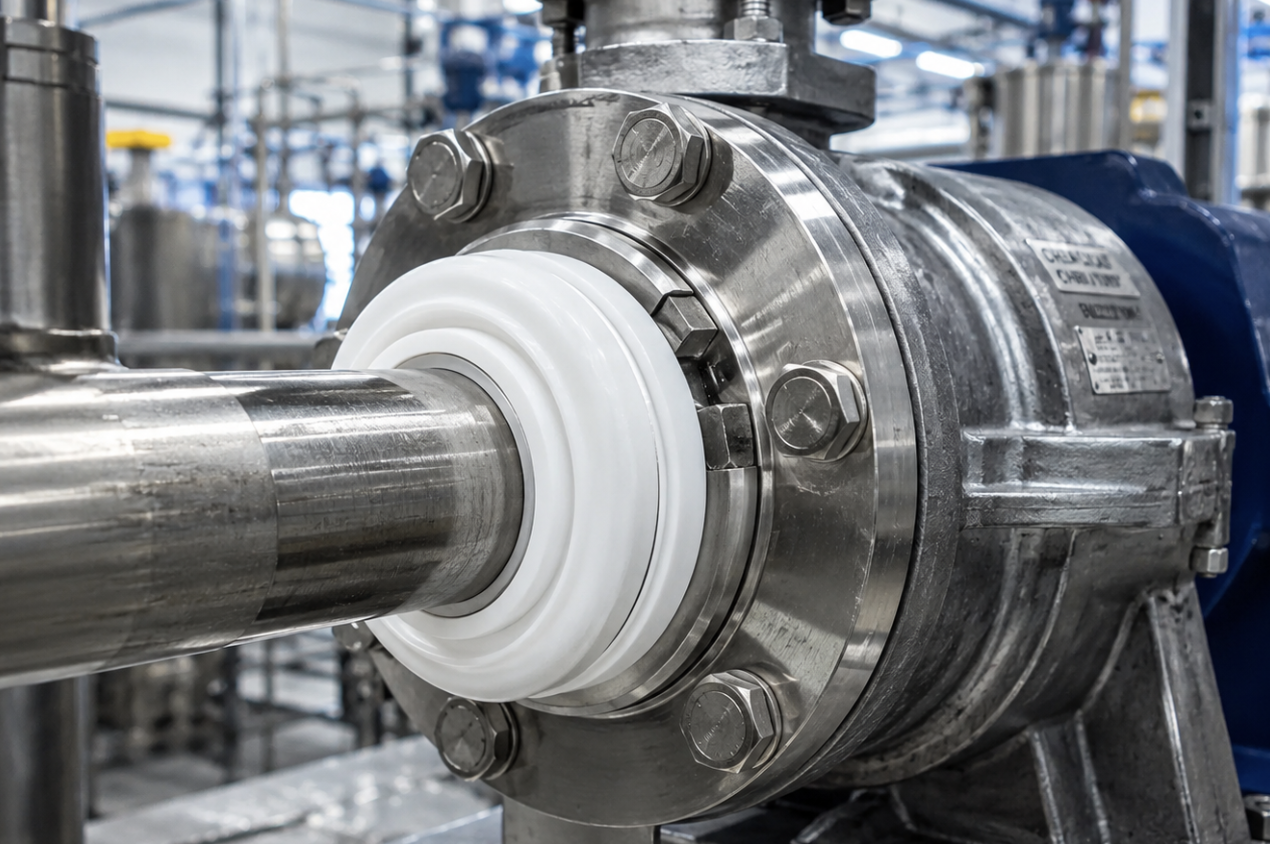
Protecting auxiliary mechanical components from harsh media remains essential for long-term operational success in chemical plants. Standard internal mechanical seals expose their loading springs directly to the circulating process fluid. In acidic lines, this direct exposure causes rapid stress corrosion cracking and pitting along the delicate metal coils. To eliminate this risk, modern system designs position the mechanical seal externally on the pump stuffing box. The external mounting configuration positions the spring and bellows outside the fluid chamber, preventing direct contact between the metal springs and the corrosive process fluid.
Consequently, the secondary spring subsystems never come into direct contact with hazardous chemicals or acidic vapors. The metal springs stay safe from atmospheric wash-downs and crystallization risks, maintaining their original elasticity indefinitely. This structural isolation guarantees that the springs deliver a perfectly constant axial load to the sealing faces over time. Because the springs avoid hydrogen embrittlement and corrosive pitting, the entire assembly operates with high reliability. Plant maintenance teams can also inspect the external springs visually without shutting down the entire pumping system.
Cross-Correlation Performance Benchmarks: Technical Proofing of the GW WB2 Design Matrix
Global industrial enterprises require transparent manufacturing partners to protect their heavy-duty rotating assets. The engineering facility GW SEAL (Ningbo Guowei Mechanical Seals Technology Co., Ltd) addresses this market demand with high-performance fluoropolymer products. Specifically, the technical team refines its specialized PTFE bellows mechanical seal line to deliver a reliable alternative to classic John Crane WB2 structures. This precise dimensional matching allows processing plants to upgrade volatile systems without modifying existing pump casings.
The quality assurance division of GW SEAL monitors the sintering and compaction cycles meticulously to guarantee a high-purity polymer structure. This strict processing control eliminates microscopic defects, ensuring that the finished components withstand concentrated nitric and sulfuric acids. Furthermore, Ningbo Guowei Mechanical Seals Technology Co., Ltd matches every production batch with verified material heat certificates to provide full traceability. The specialized manufacturing center integrates external spring isolation with optimized multi-lip geometry to prevent cold-flow deformation. This comprehensive approach delivers reliable containment and stabilizes system uptime across demanding chemical manufacturing networks. This focuses on lower total ownership costs.
Conclusion: Standardizing Chemical Processing Procurement Around Empirical Permeability Matrices
In conclusion, managing aggressive chemical loops safely depends on selecting materials with low permeability and high structural integrity. Evaluating polymer density metrics, multi-lip contact geometry, and external spring configurations helps procurement managers identify high-quality manufacturing options. Transitioning to advanced isostatic PTFE bellows configurations removes the operational risks of rapid metallic corrosion and elastomeric degradation. This engineered upgrade lowers total maintenance expenses and extends the service life of critical chemical processing pumps. Choosing components backed by rigorous material validation safeguards industrial process continuity and protects environmental safety. Engineering departments can review complete material specification sheets and dimensional data through GW SEAL. Explore the full catalog of specialized acid-resistant sealing solutions by visiting the official corporate website at https://www.gwseal.com/.
Ningbo Guowei Mechanical Seals Technology Co., Ltd
Ningbo Guowei Mechanical Seals Technology Co., Ltd
+ +86 574-88241891
email us here
Visit us on social media:
LinkedIn
Facebook
YouTube
Legal Disclaimer:
EIN Presswire provides this news content “as is” without warranty of any kind. We do not accept any responsibility or liability
for the accuracy, content, images, videos, licenses, completeness, legality, or reliability of the information contained in this
article. If you have any complaints or copyright issues related to this article, kindly contact the author above.

Media gallery