Construction of a perovskite/In0.47Ga0.53As thin-film heterojunction
CHENGDU, CHINA, June 25, 2026 /EINPresswire.com/ — Photodetectors require complex evaporation-based fabrication processes and exhibit relatively high dark currents and noise levels under operation. Besides, system size, cost, and the mismatch in responsivity between different types of photodetectors hinder further commercial application. Now, researchers from Dalian Minzu University have proposed the construction of a perovskite/In0.53Ga0.47As thin-film heterojunction, thereby realizing broadband photodetectors covering the deep-ultraviolet to short-wavelength infrared range.
As key optoelectronic components, photodetectors with deep-ultraviolet (DUV) to visible (Vis) to short-wavelength infrared (SWIR) full-spectral response play a critical role in daily life. Typically, commercial full-spectrum photodetectors are mainly based on conventional semiconductor materials. However, these photodetectors require complex evaporation-based fabrication processes and exhibit relatively high dark currents and noise levels under operation. At present, the most mature approach to realize DUV-Vis-SWIR full-spectrum photodetectors relies on the high integration of UV photodetectors with Vis-SWIR photodetectors. Nonetheless, issues such as system size, cost, and the mismatch in responsivity between different types of photodetectors hinder further commercial application. Therefore, the exploration and development of high-sensitivity DUV-SWIR photodetectors has become one of the current research hotspots.
To address the challenge that a single device can hardly achieve continuous detection from DUV to SWIR, the research team led by Professor Bin Dong from Dalian Minzu University proposed the construction of a perovskite/In0.47Ga0.53As thin-film heterojunction, thereby realizing broadband photodetectors covering DUV to SWIR (300–1700 nm). To overcome the problems of numerous surface and bulk defects as well as poor stability in conventional lead halide perovskites, the team systematically compared the coordination ability of hydroxyl/carbonyl groups toward Pb2+ using four natural flavonoid derivatives (flavone, 3-hydroxyflavone, kaempferol, and quercetin (QC)). The study was made available online on June 07, 2026, in the journal Opto-Electronic Advances.
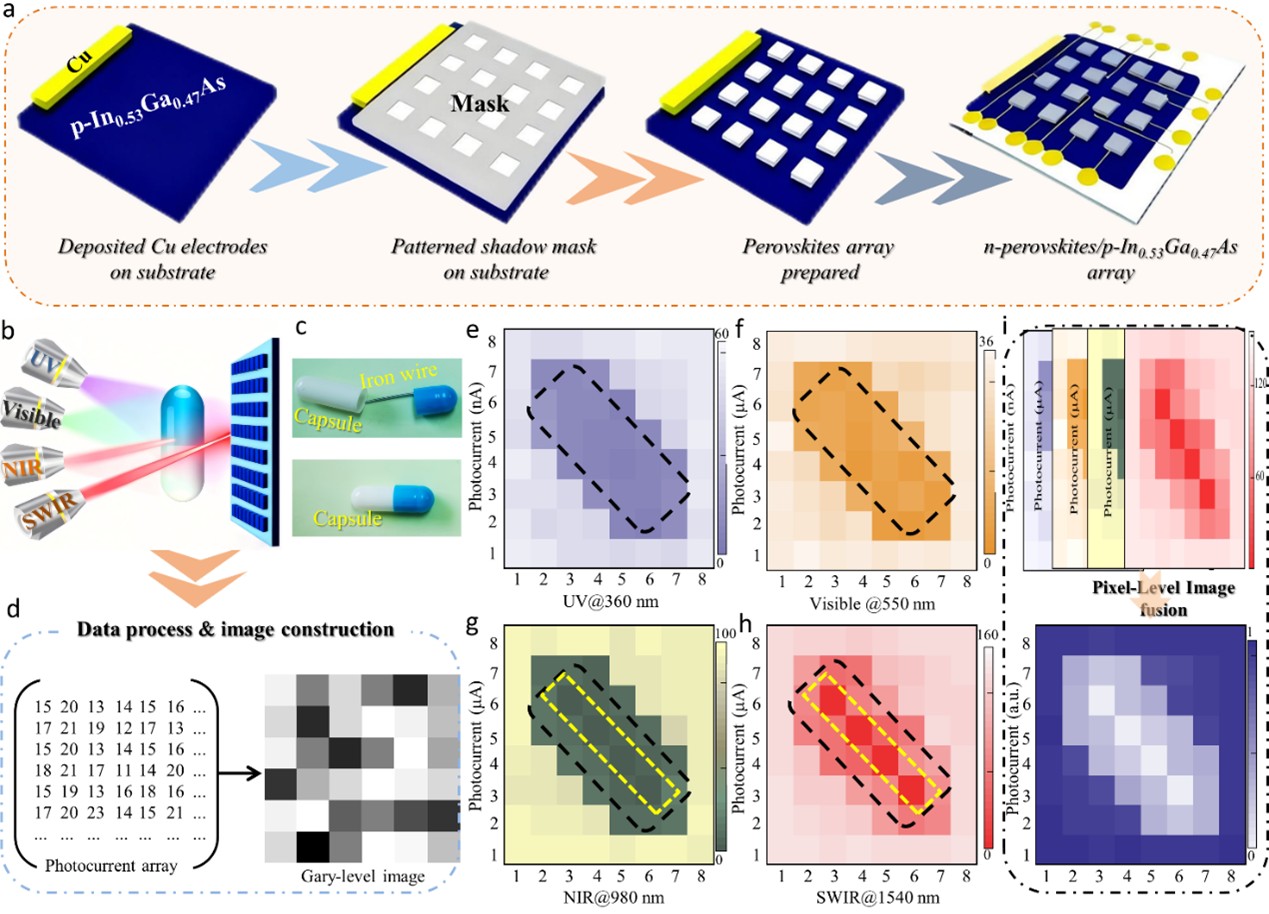
Through density functional theory calculations of defect formation energies, Kelvin probe force microscopy, ultraviolet photoelectron spectroscopy, and other optoelectronic characterization techniques, they revealed that QC, owing to its most uniform distribution of multiple acidic hydroxyl groups, can form three stable chelate rings to achieve an optimal “locking” effect on Pb2+. Meanwhile, optoelectronic performance tests on the perovskite films demonstrated that the QC-modified material exhibited the best charge transport characteristics and high long-term operational stability. Subsequently, the modified perovskite film was highly integrated with an In0.47Ga0.53As layer, achieving high-sensitivity and high-stability broadband photodetection. Measurements showed that the broadband detector retained over 98.9% of its initial performance after 30,000 consecutive ON/OFF cycles, demonstrating excellent potential for commercial applications. Furthermore, by fabricating a photodetector imaging array based on the QC-modified perovskite/In0.47Ga0.53As heterojunction, the team achieved high-sensitivity multispectral imaging from DUV to SWIR.
Reference
Title of original paper: Highly sensitive DUV-SWIR photodetectors by natural flavonoid-derivative isomers through a multisite chelation strategy
Journal: Opto-Electronic Science
DOI: https://doi.org/10.29026/oes.2026.260014
About Prof. Bin Dong from Dalian Minzu University, China
Prof. Bin Dong is the the Chief Scientist of a National Key Research and Development Program of China, Professor of the Changjiang Scholars Program of the Ministry of Education, the National Ten Thousand Talents Program for Scientific and Technological Innovation, Young and Middle-aged Scientific and Technological Innovation Leader under the Ministry of Science and Technology. He is primarily engaged in fundamental and applied research on rare-earth optoelectronic materials and device physics.
About Prof. Wen Xu from Dalian Minzu University, China
Prof. Wen Xu is the Professor of the School of Physics and Materials Engineering of Dalian Minzu University, and the National Natural Science Foundation of China’s Excellent Young Scientist Fund. He is primarily engaged in research on rare-earth luminescence and optoelectronic devices. He has published over 70 SCI-indexed papers as the first/corresponding author in journals such as Adv. Mater., Angew. Chem., Light: Sci. & Appl., and Nano Lett., with more than 6,000 citations. He has filed or been granted over 10 invention patents.
Funding information
This work was supported by National Key Research and Development Program of China (2024YFA1409900), National Natural Science Foundation of China (12404450, 62575047, U24A2018, U2441222, 62222502), the Science and Technique Foundation of Liaoning Province (2023JH2/101800012, 2024JH2/102400021, 2024JH3/50100028), and Science and Technique Foundation of Dalian (2022JJ11CG003).
Conor Lovett
Compuscript Ltd
+353 61475205
c.lovett@cvia-journal.org
Legal Disclaimer:
EIN Presswire provides this news content “as is” without warranty of any kind. We do not accept any responsibility or liability
for the accuracy, content, images, videos, licenses, completeness, legality, or reliability of the information contained in this
article. If you have any complaints or copyright issues related to this article, kindly contact the author above.

Media gallery