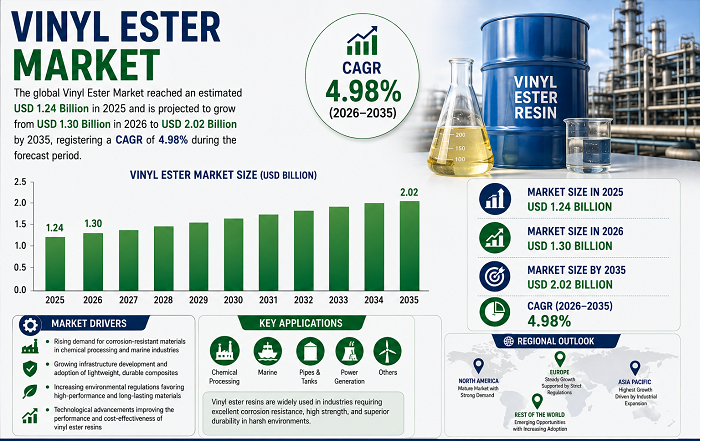
NEW YORK, NY, UNITED STATES, August 27, 2026 /EINPresswire.com/ — The global vinyl ester market is a specialized but vital segment of the broader chemicals and materials industry. It is valued for its superior corrosion resistance, mechanical strength, and durability, making it the material of choice for applications where standard polyester or even epoxy resins fall short. The market is on a steady growth trajectory, driven by demand from key industrial sectors and a push for more sustainable, high-performance materials.
Market Size and Growth Projections
While exact figures vary among research firms, the consensus points to a robust and growing market. Several market research reports provide the following estimates for market valuation:
A prominent analysis valued the market at USD 1.41 billion in 2025, projecting it to reach USD 2.5 billion by 2034, at a CAGR of 6.54% .
Another report estimated the 2025 market size at USD 1.31 billion, forecasting growth to USD 2.28 billion by 2035 at a CAGR of 5.7% .
A separate study offered a slightly different perspective, projecting the market at USD 1.19 billion in 2025 and expecting it to reach USD 2.08 billion by 2033 at a CAGR of 7.2% .
Despite minor variations, the data collectively indicate a market poised for significant expansion, with a compound annual growth rate in the range of 5.5% to 7.2%.
Get Sample @ https://www.marketresearchfuture.com/sample_request/4848
Key Drivers of Market Growth
The market is propelled by vinyl ester’s unique properties and its growing adoption across several high-value, performance-critical end-use industries.
1. Superior Performance in Corrosive Environments
Vinyl ester resins are renowned for their exceptional resistance to chemicals, corrosion, and hydrolysis. This makes them indispensable for constructing pipes, tanks, and process vessels in the chemical processing, oil & gas, and wastewater treatment industries . The ability to withstand harsh conditions and extend the service life of critical infrastructure is a primary driver of demand .
2. Growth in the Marine Industry
Vinyl ester’s excellent water barrier resistance and ability to prevent osmotic blistering make it an ideal material for marine applications, including boat hulls, decks, and tie coats . As a significant portion of global trade is transported by sea, the marine industry’s continuous expansion is a major growth driver .
3. Increasing Demand from the Wind Energy Sector
The wind energy sector relies on vinyl ester for manufacturing durable, weather-resistant composite components, such as wind turbine blades . As the world invests more heavily in renewable energy, this application is expected to become an increasingly important growth vector .
4. Expanding Applications in Building & Infrastructure
Vinyl ester is gaining traction in construction for bridge rehabilitation, infrastructure repair, and corrosion-proof coatings. Its ability to strengthen and protect concrete and steel structures provides a long-term, cost-effective alternative to traditional materials, driving growth in the building and infrastructure segment .
Buy Now @ https://www.marketresearchfuture.com/checkout?currency=one_user-USD&report_id=4848
Key Market Trends
Several important trends are shaping the competitive landscape and future direction of the market.
Shift Towards Sustainability: There is a notable industry trend toward developing low-VOC (volatile organic compound) and bio-based vinyl ester resins to meet stricter environmental regulations and rising demand for greener materials .
Focus on Advanced Manufacturing and R&D: Leading players are investing heavily in R&D to produce innovative formulations that offer enhanced mechanical properties, such as fire and heat resistance, to capture premium market applications .
Geographic Dynamics: The market is global, but Asia-Pacific is rapidly emerging as a dominant force. Rapid industrialization, extensive shipbuilding, and infrastructure development in countries like China and India are creating substantial demand . At the same time, North America and Europe remain significant markets, driven by industrial growth and a focus on infrastructure rehabilitation .
Challenges and Restraints
Despite its positive outlook, the market faces significant challenges. The primary restraint is the relatively high cost of vinyl ester resins compared to more common alternatives like polyester and standard epoxy resins . This price sensitivity limits its adoption in cost-constrained applications. Additionally, regulatory pressures and the availability of viable substitutes are factors that suppliers must strategically navigate .
Read More @ https://www.marketresearchfuture.com/reports/vinyl-ester-market-4848
Browse More Reports:
Red Brick Market https://www.marketresearchfuture.com/reports/red-brick-market-12071
Ester Market https://www.marketresearchfuture.com/reports/ester-market-5531
stainless steel foil market https://www.marketresearchfuture.com/reports/stainless-steel-foil-market-25671
non oxide ceramic market https://www.marketresearchfuture.com/reports/non-oxide-ceramic-market-37510
quaternary ammonium salt market https://www.marketresearchfuture.com/reports/quaternary-ammonium-salt-market-38094
Nanocellulose Market https://www.marketresearchfuture.com/reports/nanocellulose-market-4554
Market Research Future
Market Research Future
+1 855-661-4441
email us here
Legal Disclaimer:
EIN Presswire provides this news content “as is” without warranty of any kind. We do not accept any responsibility or liability
for the accuracy, content, images, videos, licenses, completeness, legality, or reliability of the information contained in this
article. If you have any complaints or copyright issues related to this article, kindly contact the author above.

Media gallery