The Business Research Company’s Modular Robotics Global Market Report 2026 – Market Size, Trends, And Forecast 2026-2035
LONDON, GREATER LONDON, UNITED KINGDOM, October 26, 2026 /EINPresswire.com/ — The modular robotics sector is experiencing rapid advancements as industries increasingly seek adaptable automation solutions for diverse applications. This evolving market, nested within the larger industrial robotics and machinery landscape, showcases promising growth prospects driven by technological innovations and rising demand for flexible manufacturing systems. Let’s explore the current market size, leading regions and countries, growth drivers, key segments, and competitive dynamics shaping the modular robotics industry through 2030.
Market Size and Its Position Within the Broader Robotics Industry
By 2030, the modular robotics market is projected to exceed $10 billion. When compared with its parent market, industrial robots, which is expected to reach around $143 billion in the same year, modular robotics will constitute roughly 7% of that total. Looking further at the entire machinery industry, anticipated to be valued at $5,280 billion by 2030, modular robotics will represent close to 0.2% of the aggregate market value, highlighting its emerging yet significant role within the sector.
Request A Free Sample Of The Modular Robotics Market Report
https://thebusinessresearchcompany.com/sample_request?id=56614609&type=smp&name=Modular%20Robotics%20Market%20Report%202026&utm_source=EINPresswire&utm_medium=Paid&utm_campaign=Oct_PR
North America as the Leading Region for Modular Robotics by 2030
In 2030, North America is expected to dominate the modular robotics market, with an estimated valuation of $3.7 billion. The market there is set to grow impressively from $0.9 billion in 2025, reflecting a strong compound annual growth rate (CAGR) of 34%. This surge is largely fueled by widespread adoption of versatile and reconfigurable robotic systems in manufacturing and industrial settings. Additionally, growing automation requirements in warehouses and logistics, investments in collaborative robotics, and smart factory initiatives are pushing the market forward. Integration of AI, machine learning, and sensor technologies, especially within the U.S. and Canadian industries, is also bolstering operational efficiency and production adaptability.
The United States as the Top Country in the Modular Robotics Market by 2030
Among individual countries, the United States is projected to be the largest modular robotics market in 2030, valued at around $3.0 billion. Starting from $0.7 billion in 2025, it will grow with a CAGR of 33%. Factors contributing to this rapid expansion include rising need for adaptable robotic platforms in manufacturing, increasing use of modular robots in healthcare, defense, and commercial sectors, and demand for quick deployment and customization of robotic solutions. The country’s robust research and innovation environment, plus growing investments in advanced robotics startups, further support this growth trajectory.
Access The Detailed Modular Robotics Market Report Here
https://thebusinessresearchcompany.com/report/modular-robotics-global-market-report?utm_source=EINPresswire&utm_medium=Paid&utm_campaign=Oct_PR
The Dominance of Articulated Modular Robots in the Market
When broken down by product type, articulated modular robots will hold the largest share of the modular robotics market, capturing 41% and approximately $4 billion of the total by 2030. This segment benefits from growing requirements for multi-axis robotic systems in complex industrial processes such as assembly, welding, material handling, and precision manufacturing. Innovation in robotic arms, motion control, vision systems, and advanced sensors is enhancing these robots’ capabilities, leading to broader use across automotive, electronics, healthcare, and industrial domains.
Hardware Design and Configuration Segments Within Modular Robotics
The modular robotics market is further categorized by hardware architecture into chain-based, lattice-based, and strut-based designs. In terms of configuration approaches, the market includes auto-configuration and manual configuration systems, each catering to different operational flexibility and complexity needs.
End-Use Industries Driving Modular Robotics Adoption
End users of modular robotics span diverse sectors including automotive, electronics and electrical, chemical, food and beverages, pharmaceuticals, and others. The demand across these industries reflects a common pursuit of increased automation, flexibility, and operational efficiency.
Projected Growth Rate Leading Up to 2030
The modular robotics market is forecasted to expand at a robust CAGR of 33% from 2025 through 2030, underscoring its rapid adoption and development within the broader automation ecosystem.
Industry 4.0 and Smart Manufacturing as Critical Growth Catalysts
A key driver behind the modular robotics market’s rapid growth is the increasing adoption of Industry 4.0 principles and smart manufacturing methods. These trends emphasize the necessity for flexible, intelligent automation that can be easily reconfigured to adapt to dynamic production environments. Manufacturers are leveraging modular robotics to enhance efficiency, minimize downtime, and enable real-time adjustments in production processes. The fusion of AI, the Internet of Things (IoT), and advanced sensing technologies further improves the adaptability and productivity of these robotic platforms. Growth in sectors such as automotive, electronics, logistics, and industrial manufacturing is expected to support an annual 2.7% contribution to market expansion from these factors.
Rising Demand for Reconfigurable and Scalable Robotics Solutions
Another major influence accelerating modular robotics adoption is the growing preference for robotic systems that can be reconfigured and scaled according to changing production demands. Modular robots’ ability to adapt configurations and perform multiple tasks without full system replacements enables manufacturers to cut costs, boost efficiency, and respond quickly to market fluctuations. Industries including automotive, electronics, logistics, and healthcare increasingly favor scalable robotics platforms for customized and high-variety production. This trend is projected to add roughly 2.5% per year to market growth.
Warehouse Automation and Autonomous Robotics Driving Market Expansion
The surge in warehouse automation and autonomous robotics applications also plays a pivotal role in the modular robotics market growth. Modular robotic systems are gaining traction for material handling, sorting, inventory control, and autonomous movement tasks in logistics operations. The rapid rise of e-commerce and omnichannel retailing heightens the demand for faster, more accurate, and efficient warehouse automation. Incorporating AI, sensors, and autonomous navigation enhances the performance and scalability of modular robots. Consequently, the expansion of these automation solutions is expected to contribute around 2.2% annual growth in the market.
Promising Growth Segments and Opportunities in Modular Robotics by 2030
Key growth opportunities lie within the SCARA modular robots, articulated modular robots, cartesian modular robots, parallel modular robots, and other product types segments. Combined, these areas are forecasted to generate over $8 billion by 2030. This momentum is driven by the increasing use of reconfigurable robotic systems in flexible manufacturing, growing demand for automation in precision production, expanding collaborative robotics applications, and the rise of electronics and semiconductor manufacturing needing adaptable robotic solutions. The accelerating adoption of modular architectures facilitates faster upgrades and customization, supporting operational flexibility and scalable automation.
Market leaders anticipate substantial growth within the next five years with the SCARA segment expanding by $2 billion, the articulated segment by $3 billion, and the cartesian, parallel, and other types each adding roughly $1 billion between 2025 and 2030. This dynamic market is shaped by a mix of global robotics manufacturers and specialized automation providers focusing on advanced modular systems, intelligent control, and flexible automation platforms designed to meet evolving industrial needs.
Leading Player in the Modular Robotics Market
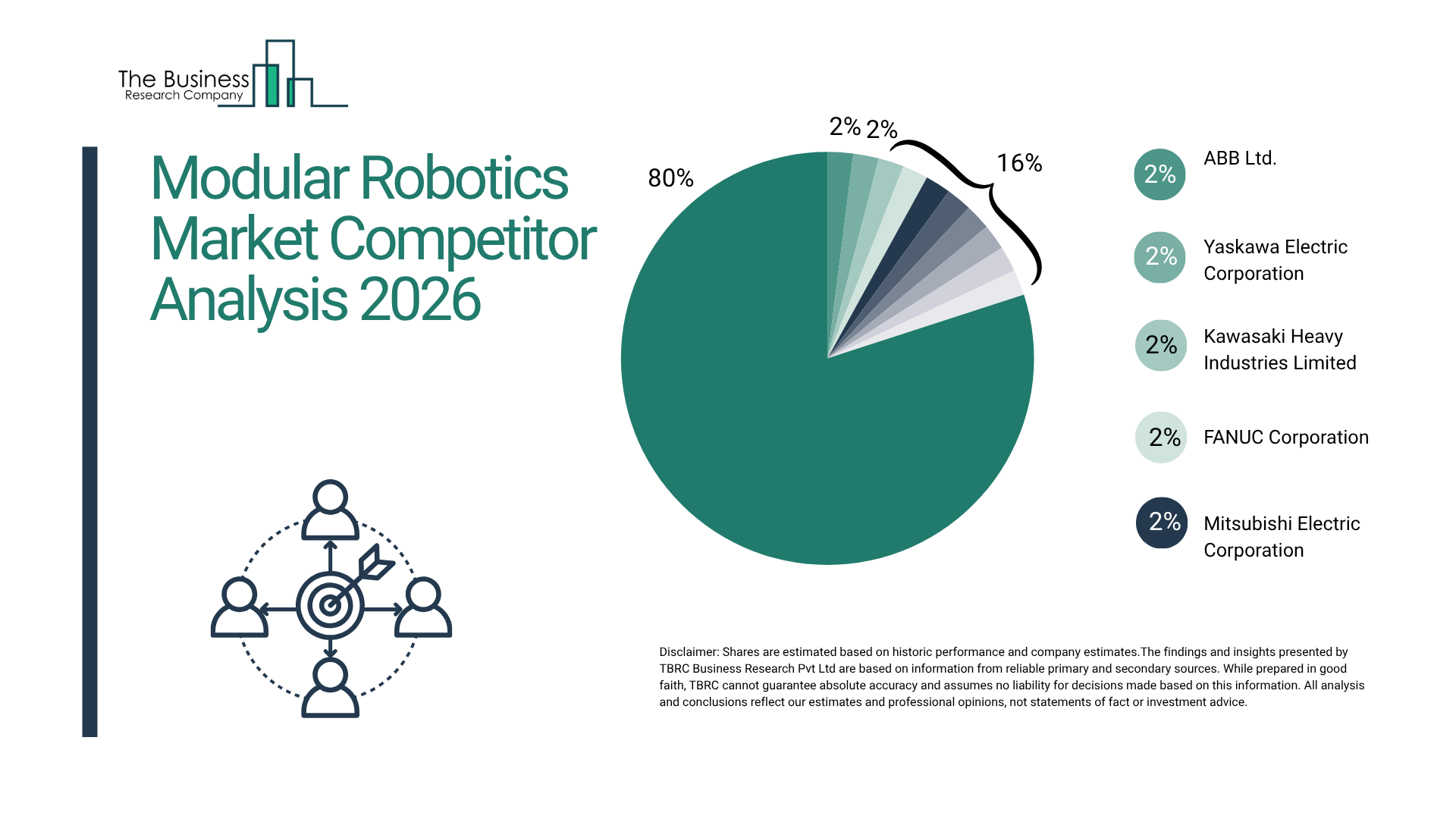
According to research, ABB Ltd. led global modular robotics sales in 2025 with a 2% market share. ABB’s robotics and automation division offers an extensive portfolio of modular robotic systems, industrial robots, automation solutions, and intelligent control technologies designed to support flexible manufacturing and advanced robotic applications.
Key Companies Competing in the Modular Robotics Space
Prominent organizations active in the modular robotics market include ABB Ltd., Yaskawa Electric Corporation, Kawasaki Heavy Industries Limited, FANUC Corporation, Mitsubishi Electric Corporation, KUKA AG, Teradyne (Universal Robots A/S), Stäubli International AG, Omron Adept Technologies Inc., Comau SPA, Nachi-Fujikoshi Corporation, DENSO Corporation, Yamaha Motor Co. Ltd., Delta Electronics Inc., Robert Bosch GmbH, Shibaura Machine, Rethink Robotics GmbH, Acmi SpA, Adept Technology Inc., Acutronic Robotics, and LEGO System AS.
Market Concentration and Competitive Landscape
The modular robotics market is moderately fragmented, with the top 10 companies accounting for 20% of total revenues in 2025. This reflects balanced entry barriers associated with robotics engineering, automation integration, software standards, and precision requirements. Leading firms maintain strong positions through diversified product lines, global distribution channels, innovation, and partnerships in industrial automation. As demand for flexible, AI-enhanced, and collaborative robotic platforms grows, competition is expected to intensify through strategic alliances, product development, and geographic expansion.
Critical Suppliers of Raw Materials for Modular Robotics
Major suppliers of raw materials and key components include Intel Corporation, NVIDIA Corporation, Advanced Micro Devices Inc., Qualcomm Incorporated, Texas Instruments Incorporated, STMicroelectronics N.V., Infineon Technologies AG, NXP Semiconductors N.V., Analog Devices Inc., Microchip Technology Incorporated, Renesas Electronics Corporation, Broadcom Inc., Sony Semiconductor Solutions Corporation, ABB Ltd., Siemens AG, Bosch Rexroth AG, Harmonic Drive Systems Inc., Schaeffler AG, NSK Ltd., SKF AB, Mitsubishi Electric Corporation, Yaskawa Electric Corporation, Omron Corporation, and KUKA AG.
Leading Wholesalers and Distributors in the Modular Robotics Market
Prominent wholesalers and distributors serving the modular robotics sector include Arrow Electronics Inc., Avnet Inc., Ingram Micro Inc., Tech Data Corporation, Synnex Corporation, Digi-Key Electronics, Mouser Electronics Inc., Future Electronics Inc., RS Components Limited, Newark Electronics, TTI Inc., Allied Electronics & Automation, Macnica Inc., EET Group A/S, ScanSource Inc., Westcon Group, Exclusive Networks SA, ALSO Holding AG, Esprinet S.p.A., Redington Limited, Mindware FZ LLC, Logicom Public Limited, ASBIS Enterprises PLC, Bechtle AG, and CDW Corporation.
Major End Users Driving Demand for Modular Robotics
Key end users of modular robotics include industry giants such as Toyota Motor Corporation, Tesla Inc., BMW Group, Volkswagen AG, Ford Motor Company, General Motors Company, Hyundai Motor Company, Samsung Electronics Co. Ltd., Foxconn Technology Group, Apple Inc., Panasonic Holdings Corporation, Sony Group Corporation, Amazon.com Inc., DHL Group, FedEx Corporation, United Parcel Service Inc., Walmart Inc., Bosch Group, Caterpillar Inc., Deere & Company, Procter & Gamble Company, Unilever PLC, Nestlé S.A., and Pfizer Inc.
Competitive Trends Transforming the Modular Robotics Market
Modular robotics are revolutionizing production by enabling highly flexible, quickly deployable, and scalable systems across multiple industrial sites. For instance, in July 2025, Vention introduced its Rapid Series Palletizer—a plug-and-play modular automation solution designed for end-of-line manufacturing. Built on the FastFactory ecosystem, it supports fast deployment, customizable setups, real-time analytics, and remote assistance, helping manufacturers optimize workflows and expand automation efficiently.
Strategies Adopted by Companies to Stay Ahead
Market leaders are advancing modular robotic platforms to enhance reconfigurable automation and production. They are focusing on plug-and-play modules to improve flexibility and speed of deployment, expanding industrial adoption to boost efficiency and smart factory transformations, and integrating AI control systems to increase autonomy and real-time adaptability. These strategic moves position companies to capitalize on growing demand for scalable, intelligent automation solutions in diverse industries.
Our 2026 market reports now feature expanded strategic intelligence through market attractiveness scoring and analysis, total addressable market (TAM) analysis, company scoring matrix graphics and tables, Excel-based dashboards, market hotspots infographics, key technology and future trend analysis, along with updated graphics and tables.
Learn More About The Business Research Company
The Business Research Company (www.thebusinessresearchcompany.com) is a leading market intelligence firm renowned for its expertise in company, market, and consumer research. We have published over 30,000+ reports across 27 industries and 60+ geographies. Our research is powered by 1,500,000 datasets, extensive secondary research, and exclusive insights from interviews with industry leaders.
We provide continuous and custom research services, offering a range of specialized packages tailored to your needs, including Market Entry Research Package, Competitor Tracking Package, Supplier & Distributor Package and much more.
Disclaimer: Please note that the findings, conclusions and recommendations that TBRC Business Research Pvt Ltd delivers are based on information gathered in good faith from both primary and secondary sources, whose accuracy we are not always in a position to guarantee. As such TBRC Business Research Pvt Ltd can accept no liability whatever for actions taken based on any information that may subsequently prove to be incorrect. Analysis and findings included in TBRC reports and presentations are our estimates, opinions and are not intended as statements of fact or investment guidance.
Contact Us:
The Business Research Company
Americas +1 310-496-7795
Europe +44 7882 955267
Asia & Others +44 7882 955267 & +91 8897263534
Email: marketing@tbrc.info
Follow Us On:
LinkedIn: https://in.linkedin.com/company/the-business-research-company
Oliver Guirdham
The Business Research Company
+44 7882 955267
Visit us on social media:
LinkedIn
Facebook
X
Legal Disclaimer:
EIN Presswire provides this news content “as is” without warranty of any kind. We do not accept any responsibility or liability
for the accuracy, content, images, videos, licenses, completeness, legality, or reliability of the information contained in this
article. If you have any complaints or copyright issues related to this article, kindly contact the author above.

Media gallery